
Candles decorated with dried flowers can look beautiful. Rose petals, lavender buds and small pieces of foliage give an ordinary candle a handmade, botanical appearance. But are they actually safe to burn?
Putting dried flowers into a candle can create a fire hazard. The problem isn’t the flower itself while the candle is sitting unlit. It’s what happens when the wax melts and the dried material comes into contact with the flame.
For candles intended to be burned, the safest approach is to keep dried flowers, herbs and other flammable decorations out of the wax altogether.
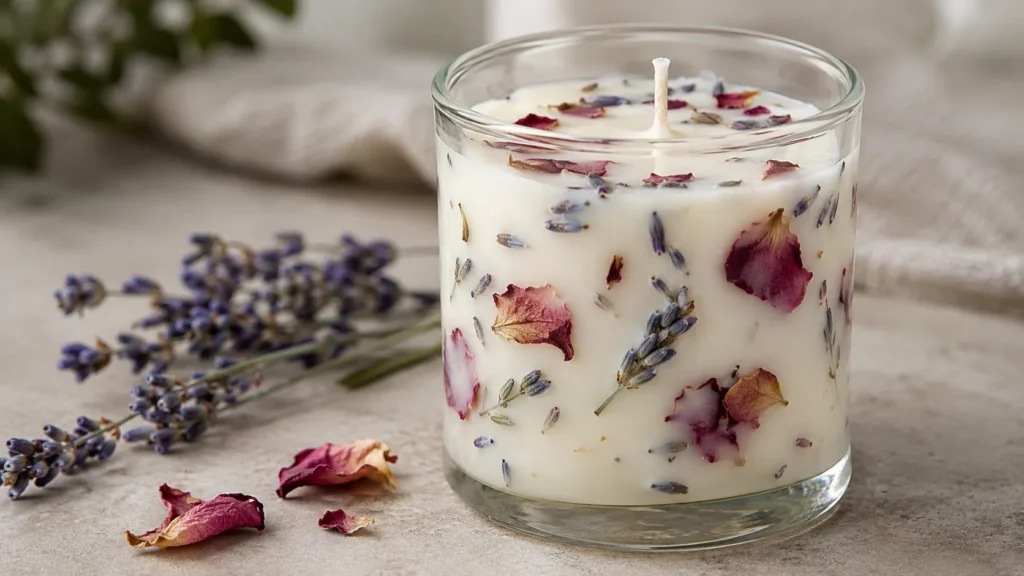
Why are dried flowers in candles dangerous?
Dried flowers are combustible. Although they may be surrounded by wax when a candle is first made, that doesn’t mean they’ll remain safely in place as it burns.
As the candle heats up, a pool of liquid wax forms around the wick. Flower petals, leaves or other decorative material can become exposed, move through the melted wax or come into contact with the flame.
When that happens, the decoration may ignite and behave like an additional wick. Instead of one controlled flame, the candle can develop several burning points.
This is known as secondary ignition, and it can cause the candle to generate considerably more heat than intended.
Have dried-flower candles actually been tested?
Yes. In 2022, the National Candle Association commissioned independent laboratory testing of three candles containing botanical decorations.
Two of those candles experienced secondary ignition, meaning material other than the intended wick caught fire.
In one test, the burning botanical material generated enough heat for fire to spread across the surface of the wax.
The sample was small, so the findings don’t tell us how frequently decorative candles catch fire. They do demonstrate that the risk is real, rather than merely theoretical.
In the UK, joint guidance from Trading Standards and the British Candlemakers Federation also identifies decorative inclusions, including seeds, flower petals and dried fruit, as potential causes of candle fires.
It’s a good reason to look beyond a candle’s appearance when deciding whether it’s suitable for burning.
Are dried flowers safe if they’re placed away from the wick?
You may have seen candles with flowers arranged neatly around the outer edge, leaving a clear circle around the wick.
It looks like a sensible precaution, but distance from the wick when the candle is cold doesn’t guarantee safety throughout its burn.
The melt pool gets wider as the candle burns. Decorative material that was initially sitting in solid wax may eventually become exposed or move closer to the flame.
Some specialist decorative pillar candles are designed to burn down the centre while keeping their outer walls intact. However, that design requires appropriate testing to establish that the decorations cannot reach the flame.
Simply pushing dried flowers towards the edge of a homemade candle isn’t the same thing.
What about lavender, rose petals and dried herbs?
The same basic concern applies to all combustible plant material placed in candle wax.
- Dried lavender: Loose buds and brittle stems can become additional fuel if they reach the flame.
- Dried rose petals: Thin, lightweight petals may move as the surrounding wax melts.
- Rosemary and other dried herbs: Leaves and stems are combustible, even when used in small quantities.
- Cinnamon sticks and dried fruit: These may look attractive in festive candles but introduce additional material that can catch fire.
Using natural ingredients doesn’t remove the risk. A dried lavender bud is still dried plant material, regardless of whether the candle contains soy, paraffin, beeswax or another type of wax.
Are crystals and glitter safe inside candles?
Crystals, stones and glitter are sometimes used to decorate candles too, although they don’t all present the same hazards as dried flowers.
A stone isn’t combustible in the way a dried petal is. However, placing an object inside a candle can still affect how it burns, introduce unwanted materials into the melt pool or create problems when heated.
Some glitter and decorative materials may also be unsuitable for exposure to a candle flame.
Rather than assuming a decoration is safe because it doesn’t look flammable, it’s better to choose a candle that has been properly designed and tested for its intended use.
Can you remove the dried flowers before lighting a candle?
If you’ve bought a candle with loose dried flowers sitting on top, removing them before lighting may eliminate that particular source of combustible material.
However, check whether more flowers or other decorations are embedded beneath the surface. Removing the visible petals doesn’t establish that the remaining candle is safe to burn.
If you’re unsure, contact the manufacturer for guidance. If the candle contains decorative material throughout the wax, the safer choice is not to light it.
You can still keep a decorative candle on display without burning it, provided it’s stored safely away from heat and other ignition sources.
How can you get the botanical look without putting flowers in the wax?
There are plenty of ways to give a candle a floral or natural appearance without introducing combustible material into the burning wax.
Printed botanical illustrations on the label are one option. Packaging can also feature dried flowers or foliage, provided removable decorative materials are taken away before lighting the candle.
Another approach is to display a simple candle alongside a separate arrangement of dried flowers, keeping the arrangement well away from the flame, hot container and surrounding heat.
If it’s the fragrance you’re interested in, you don’t need actual lavender buds or rose petals inside the candle to enjoy a floral scent. The fragrance can be incorporated into the candle without adding physical flowers.
What should you look for when buying decorative candles?
Before buying a candle, particularly a handmade one with unusual decorations, look at what has actually been placed in or around the wax.
A candle designed purely for display is different from one intended to be burned. If the product contains flowers, herbs or other objects, check the manufacturer’s instructions and whether it’s suitable for lighting.
Even a candle without decorations needs sensible care. Place it on a stable, heat-resistant surface, keep it clear of flammable objects and never leave it burning unattended.
Our candle care guide covers the precautions worth following every time you light a candle.
Are dried flowers in candles worth the risk?
There’s no denying that dried-flower candles can look lovely, especially when they’re unlit. But appearance and safe burning are two different considerations.
Plant material inside the wax can become exposed as the candle burns, and there is documented evidence of botanical decorations catching fire.
For an everyday scented candle, it’s better to leave the flowers to the label, packaging or a separate display.
You can still enjoy the scent of lavender, rose or other botanicals without having the actual plant material sitting beside an open flame.
Further reading: The National Candle Association’s warning on botanical candles and the Scottish Fire and Rescue Service’s candle safety advice.