
No products in the cart.

A scented candle seems harmless enough sitting on a coffee table, but it’s easy to forget that there’s an open flame burning in the middle of it. And while candles can be enjoyed safely with a little care, they are responsible for house fires every year.
Most candle-related accidents involve ordinary things: a curtain hanging too close, a candle knocked over or a flame left burning while someone leaves the room. Sometimes the candle itself can develop a problem, particularly if it overheats or burns with an unusually large flame.
Understanding how these fires start is one of the best ways to prevent them.
What causes candles to start fires?
1. Flammable objects too close to the flame
One of the biggest risks is placing a candle near something that can catch fire.
Curtains, books, paper decorations and soft furnishings can all ignite if they come into contact with a flame. Even something that seems safely out of the way can become a problem if it moves in a draught or falls towards the candle.
Think about a Christmas card standing on a mantelpiece or a curtain moving beside an open window. Neither seems particularly dangerous until it comes too close to a burning wick.
Keep plenty of clear space around a candle, including above it. A useful precaution is to maintain at least 30 cm of clearance from combustible materials, with additional space wherever necessary. Never position a burning candle directly beneath a shelf.
2. Leaving a candle unattended
It’s tempting to leave a candle burning while you pop into the kitchen or head upstairs for a few minutes. But an unattended flame can turn a small accident into something much more serious.
A pet might knock the candle over, a wick could begin burning unusually high or something nearby could fall against the container.
Always extinguish candles before leaving the room or going to sleep. If you’re feeling particularly tired, it’s better not to light one in the first place.
3. An unstable or unsuitable surface
Even a candle in a heavy glass jar can be knocked over.
Choose a flat, stable, heat-resistant surface where the candle won’t be disturbed. Avoid narrow shelves, table edges or somewhere people regularly reach across.
The surface beneath a candle matters too. Glass jars and metal containers can become very hot, particularly towards the end of a candle’s life.
Placing a candle directly on an unsuitable surface can cause heat damage and potentially create a fire hazard.
4. A wick that’s too long or a flame that’s too large
A candle should generally burn with a reasonably steady, controlled flame.
If the wick becomes excessively long, the flame may grow taller, produce more soot and generate more heat than intended. An unsuitable wick or candle formulation can cause similar problems.
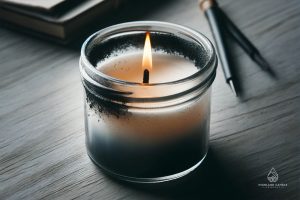
Watch for persistent smoking, an unusually large flame or excessive soot collecting around the container.
If this happens, extinguish the candle safely and allow it to cool completely. Check the wick and burning conditions before relighting. If the problem continues, stop using the candle.
Our article on why candle jars turn black explains more about soot and uneven burning.
5. Burning a candle too close to the bottom
Trying to use every last bit of wax isn’t worth the risk.
As the wax level falls, heat can become concentrated near the bottom of the container. This may cause the glass to overheat or crack, especially if the candle isn’t burning correctly.
The National Candle Association recommends stopping when approximately 12 mm of wax remains in a container candle. Always follow the manufacturer’s instructions if they require you to stop sooner.
A cracked, leaking or otherwise damaged candle container should never be reused for burning.
How to prevent candle fires at home
Most everyday precautions are simple enough to become habits. Before lighting a candle, take a few seconds to check where it is and what’s around it.
- Never leave it unattended. Extinguish the flame whenever you leave the room or go to bed.
- Keep the surrounding area clear. Curtains, decorations, books and other combustible materials should be well away from the flame.
- Use a stable, heat-resistant surface. Make sure the candle can’t easily be knocked over.
- Keep children and pets away. Place candles where they cannot be reached or accidentally disturbed.
- Check the wick. Keep it at the manufacturer’s recommended length and remove loose debris from the wax.
- Avoid draughts. Fans, open windows and vents can disturb the flame and lead to uneven burning.
- Respect the burning time. Follow the candle’s instructions and stop using it before the wax runs too low.
For a broader look at maintaining your candles, we’ve put together 11 candle care tips covering the everyday details.
Can a candle jar catch fire?
Yes, a candle in a glass or metal container can still create a fire hazard. The container doesn’t make the flame risk-free.
A damaged jar, excessive heat or a wick that burns too close to the side of the container can all cause problems. Loose wick trimmings and other debris in the wax can also ignite.
If a candle begins behaving unusually, don’t try to rescue it while it’s burning. Extinguish it safely if you can do so without putting yourself at risk, allow it to cool and investigate the problem afterwards.
What should you do if a candle starts a fire?
If a fire spreads beyond the candle, your priority is getting people to safety, not saving the candle or nearby belongings.
Leave the area, close doors behind you if it’s safe to do so, and call 999. Don’t attempt to carry a burning container or pour water onto burning candle wax, as this can cause dangerous splashing.
The Scottish Fire and Rescue Service provides further guidance on candle safety and preventing fires at home.
Enjoying candles safely
None of this means you need to be nervous about lighting a candle. It simply means treating the flame with the same care you would give any other small fire in your home.
Find somewhere stable, keep the surroundings clear, pay attention to how the candle is burning and put it out when you’re finished.
Those few habits make an enormous difference. A candle should be something you can enjoy, not something you forget is burning in the corner of the room.


About author

Related posts
Black glass is soot. Trim the wick, move it off the draught, wipe the jar. It is not the fragrance’s fault. Continue reading
Wet spots are air between wax and glass. They look like a fault. They are not. The candle will still burn. Continue reading

Candles do not expire like milk. They fade, they dust, they bloom. Most of them are still fine to burn. Continue reading

Cold throw is the lid sniff. Hot throw is the room. They are not the same, and soy is often quieter on the lid. Continue reading

Usually yes, better in the hold. Wrap them, lid on, and check the airline because staff can still say no. Continue reading