
No products in the cart.
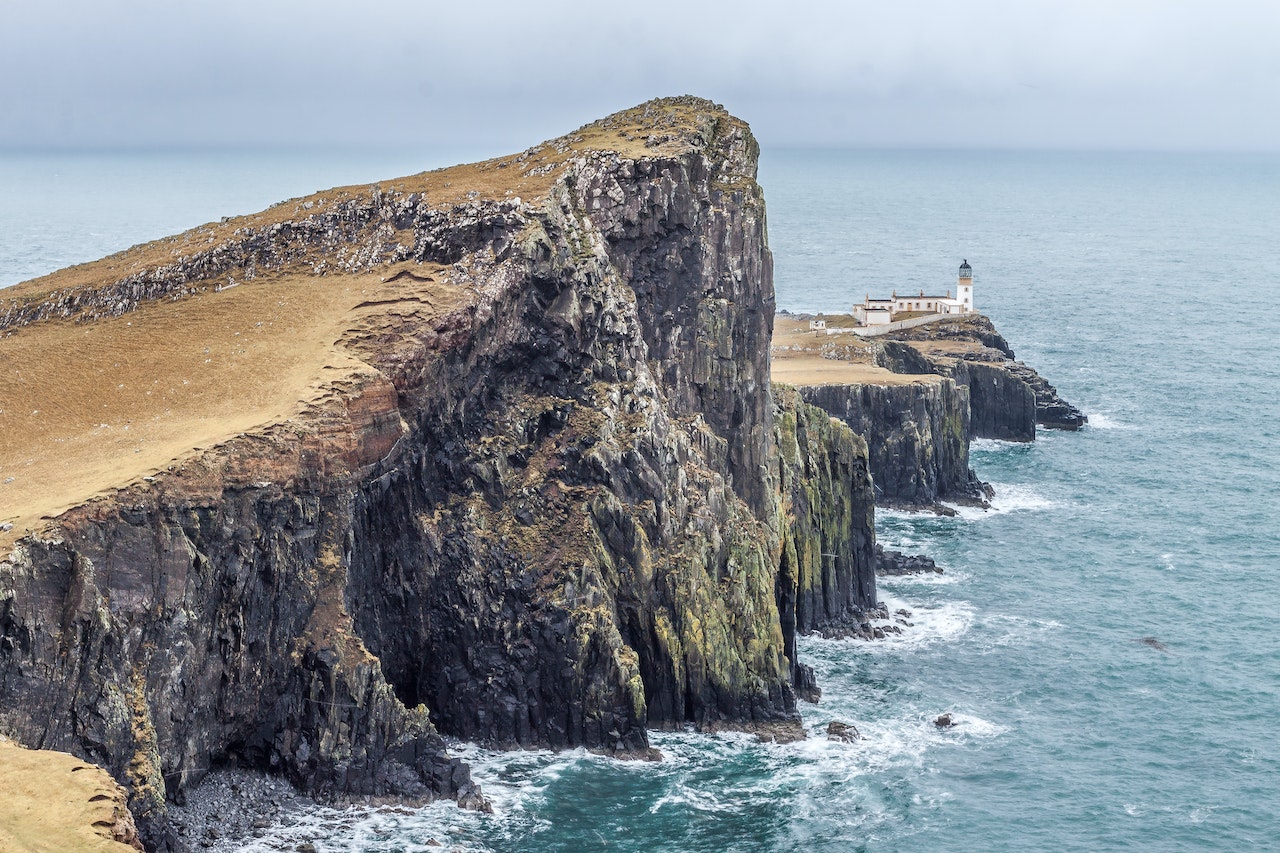
At the western edge of the Isle of Skye, a narrow headland stretches out into the sea, ending in a white lighthouse surrounded by towering cliffs. This is Neist Point, one of the island’s most photographed locations and a particularly memorable place to watch the sun go down.
Getting here takes a little effort. The road winds through the remote countryside around Glendale, and reaching the lighthouse itself involves a steep walk. But the views across the water towards the Outer Hebrides, with the sheer cliffs rising above the sea, make it a worthwhile journey.
The history of Neist Point Lighthouse
Neist Point Lighthouse was designed by David Alan Stevenson, a member of the famous Scottish family responsible for building numerous lighthouses around the country’s coastline.
Its light was first illuminated on 1 November 1909, helping ships navigate the waters between Skye and the Outer Hebrides.
For much of its early life, the lighthouse was staffed by keepers who lived in the adjoining cottages. It was a remote posting, particularly during winter, when rough seas and Atlantic storms could make life on the headland challenging.
In 1990, the lighthouse was automated, removing the need for permanent keepers. It remains an operational lighthouse today, although the tower and surrounding buildings aren’t open to visitors.
You can read more about its history on the Northern Lighthouse Board website.
Walking to Neist Point Lighthouse
The walk begins at the end of the single-track road beyond Glendale. From the parking area, a constructed path descends steeply towards the headland before continuing across the exposed landscape to the lighthouse.
The initial descent includes a long series of steps, with handrails along much of the steepest section. It’s manageable for many reasonably fit walkers, but it’s worth remembering that you’ll have to climb all those steps again on the way back.
The return walk is roughly 2–3 kilometres, depending on the route and viewpoints you explore. Allow around one to two hours, particularly if you want to stop for photographs or spend some time watching the sea.
Although there’s a proper path, the surrounding cliffs have steep, unfenced drops. Strong winds, rain and poor visibility can make the walk hazardous, so sensible footwear and suitable clothing are important. In particularly bad weather, it’s better to leave the walk for another day.
Where is the best view of Neist Point?
Interestingly, you don’t necessarily have to walk all the way to the lighthouse to enjoy the best view.
The familiar photographs of Neist Point, with the lighthouse sitting beyond a great sweep of cliffs, are usually taken from the higher ground near the car park.
A short walk along the grassy clifftop to the northwest reveals the headland stretching out below. The distinctive rocky ridge of An t-Aigeach rises prominently above the sea, with the lighthouse visible beyond it.
It’s one of the finest coastal views on Skye, particularly in the evening when the low sunlight catches the cliffs.
The grassy ground can be boggy, and the cliff edges are unprotected, so take care when exploring the viewpoints. There’s no photograph worth getting dangerously close to the edge for.
Wildlife around Neist Point
Neist Point is also a good place to look for wildlife, particularly during the warmer months.
Seabirds gather around the cliffs, while the surrounding waters offer the possibility of spotting dolphins, porpoises and occasionally minke whales. Basking sharks have also been seen in the area.
None of these sightings is guaranteed, of course, but it’s worth taking a pair of binoculars if you enjoy watching wildlife.
Even without spotting anything unusual, there’s plenty to appreciate simply by looking out across the water. On a clear day, the islands of the Outer Hebrides can be seen on the horizon.
When is the best time to visit Neist Point?
Neist Point is especially popular at sunset, and it’s easy to understand why. Facing west, the headland catches the evening light beautifully, with the lighthouse silhouetted against the sea.
During summer, however, it’s also one of Skye’s busier photography locations. The small parking area can fill up, and the narrow approach road requires patience when meeting oncoming traffic.
Visiting earlier in the day can be a good alternative if you’d prefer a quieter experience. Autumn can also be lovely, although the weather is often less predictable.
If you’re planning to stay for sunset, remember to allow enough daylight for the return walk or bring a suitable torch. The steep steps and exposed ground are not places to negotiate casually in darkness.
Is Neist Point Lighthouse worth visiting?
Very much so, particularly if you enjoy dramatic coastal scenery and don’t mind travelling a little away from Skye’s main routes.
There’s no need to enter the lighthouse to appreciate the place. Much of its appeal comes from the surrounding landscape: the cliffs, the open sea and the remarkable position of the building at the very edge of the island.
If you’re planning a longer stay, our guide to the Isle of Skye covers more of the island’s landscapes and places worth exploring.
Neist Point is impressive in photographs, but they don’t quite capture the scale of the cliffs or the feeling of standing above that enormous stretch of water. It’s well worth seeing for yourself.


About author

Related posts
Eilean Donan is a rebuilt castle on a tidal island at Dornie, where three lochs meet. Famous, photogenic, still worth the stop if you pick... Continue reading
Cairn Gorm is the named summit above Aviemore. The plateau is the real mountain. The car park is only the start. Continue reading
Skye is not named after the sky. The old names point at Norse and Gaelic. The English spelling is the latecomer. Continue reading

The creel tree is Ullapool’s Christmas: stacked fishing pots on the waterfront, lights, and not a plastic fir in sight. Continue reading
The Storr is the rock pillar on Skye’s Trotternish ridge. Steep, popular, worth it in the first hour of the day. Continue reading