
No products in the cart.

You’ve closed the windows, there’s no noticeable breeze and the room seems perfectly still. Yet your candle flame keeps flickering. What’s making it move?
It might surprise you to learn that a candle doesn’t need a draught to flicker. The flame creates its own movement in the surrounding air, and even small changes in airflow can affect how it burns.
A gentle flicker is usually nothing to worry about. If the flame is constantly dancing, growing unusually tall or producing smoke, however, it’s worth finding out why.
Why does a candle flame flicker without wind?
When a candle burns, its flame heats the air around it. That warm air rises, drawing cooler air in from the surrounding room to replace it.
This process is called convection, and it happens naturally whenever a candle is burning.
The movement of warm and cool air can cause small changes in the flame’s shape, even when the room appears completely still. It’s one reason candle flames don’t always remain perfectly motionless.
There may also be tiny air currents you simply can’t feel. Warm air rising from a radiator, someone walking through the room or air circulating around furniture can be enough to disturb a flame.
Other reasons your candle might be flickering
Although airflow is a common explanation, there are a few other things worth checking.
The wick is too long
An excessively long wick can produce a larger, less stable flame. Carbon may also build up at the tip, sometimes forming a small mushroom shape.
Keeping the wick at the manufacturer’s recommended length helps maintain a more controlled burn. Our guide to trimming candle wicks explains how to do this properly.
There are small draughts you haven’t noticed
A room doesn’t need an open window to have moving air. Heating systems, ventilation, nearby doorways and even other burning candles can create small air currents.
If the flame repeatedly leans in one direction, airflow could be responsible.
We’ve covered this further in our article on keeping candles away from draughts.
The candle isn’t burning as intended
Sometimes persistent flickering is related to the candle itself.
An unsuitable wick, excessive carbon build-up or problems with the candle’s formulation can affect flame stability. Loose debris in the melted wax can also create additional burning hazards.
If a candle continues producing an unstable flame despite being correctly maintained and positioned, it may need to be assessed by the manufacturer.
How to stop a candle flickering excessively
If your candle is flickering more than usual, start with a few simple checks.
- Check the wick. Extinguish the candle, allow it to cool completely and trim the wick if it’s longer than recommended.
- Look for hidden draughts. Check nearby windows, doors, fans, vents and radiators.
- Try another position. Once the candle has cooled and the wax has solidified, move it to a stable, sheltered surface and see whether it burns more steadily next time.
- Keep the wax free from debris. Remove loose wick trimmings or other foreign material before lighting, never while the wax is hot.
If the flame remains unusually large, repeatedly flares or produces visible trails of smoke, extinguish the candle and stop using it until the cause has been established.
Is a flickering candle dangerous?
Not every flicker is a warning sign. Small, occasional movements are a normal part of how candle flames behave.
It’s persistent, excessive flickering that can indicate a problem. An unstable flame may produce more soot, burn unevenly or generate excessive heat.
Ideally, a candle should burn with a reasonably steady, teardrop-shaped flame, without frequent flaring or visible smoke.
So if your candle moves a little in an otherwise still room, there’s no reason to be concerned simply because it’s flickering. The warm air rising from the flame may be all the explanation you need.


About author

Related posts
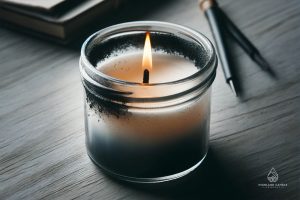
Black glass is soot. Trim the wick, move it off the draught, wipe the jar. It is not the fragrance’s fault. Continue reading
Wet spots are air between wax and glass. They look like a fault. They are not. The candle will still burn. Continue reading

Candles do not expire like milk. They fade, they dust, they bloom. Most of them are still fine to burn. Continue reading

Cold throw is the lid sniff. Hot throw is the room. They are not the same, and soy is often quieter on the lid. Continue reading

Usually yes, better in the hold. Wrap them, lid on, and check the airline because staff can still say no. Continue reading